
This brings us to Enabler 2: Senior Leadership Sponsorship, a critical factor in ensuring widespread buy-in and adoption for your program. Securing C-Suite/Executive buy-in is essential for driving a smooth program rollout and helping drive sustained interdepartmental support.

Blog
Enabler 2: Senior Leadership Sponsorship


In our last post, we established that a truly successful secure coding program must define its goals by linking them directly to critical business outcomes (Enabler 1: Defined & Measurable Success Criteria). But a successful program needs more than just goals and metrics; it needs power, visibility, and credibility derived from the top ranks of the organization.

Active Buy-In, Not Passive Awareness
For secure coding to thrive, the C-suite must be fully on board with the program. This means it is wholly necessary for leadership to be actively supportive, rather than passively aware. Leaders must fully back the “What & Why” of the program.
Crucially, the senior leaders’ names should be associated with the program and the desired business outcomes. They must believe in the fundamental link between effective secure coding practices and company-wide risk reduction.
In practice, this may look like:

Executive Participation in Program Launch - This may come in the form of email communications, company-wide kickoffs, departmental meetings, and more. They can communicate the program's rationale from the start to help build buy-in from the developer organization.
Celebrating Wins - Leadership actively celebrating developer wins can go a long way in incentivizing program participation. Whether it’s presenting awards to developers in meetings, shout-outs or kudos in company communications, or even having an executive signature on certificates of completion, it often helps developers to know that leadership is watching and appreciates their efforts.
Reviewing Value and ROI - A regular cadence of reviewing the Joint Success Plan with leadership helps ensure the program's value and return on investment (ROI) are realized. When necessary, leadership can help pull in necessary resources to help continue gaining buy-in for a program.
The Critical C-Suite Lineup
For a Secure Coding program to gain traction and strategic importance, involvement should ideally extend beyond a single leader. The essential C-level sponsors should include the CIO(s), CDO/CTO, and CISO. For larger organizations, having all three of these roles onboard is necessary.
jThese roles provide distinct areas of influence crucial for program success:
- CIO (Chief Information Officer): This person decides what the developers build in order to support and drive the business forward. In large organizations, there may be multiple business units with their own CIOs, potentially led by a Global CIO overseeing the entire IT structure.
- CDO/CTO (Chief Development Officer / Chief Technology Officer): This individual decides how the developers build. This includes establishing design standards and patterns, development tooling, application architecture, and build pipelining. It is essential that this leader buys into security so that your program can be incorporated into the engineering strategy.
- CISO (Chief Information Security Officer): This leader is charged with ensuring the developers build in a secure way. Their role is to ensure applications used by the business are secure, preventing data breaches or exposure to excessive risk.

Why the CISO Alone is Not Enough
While the CISO plays a fundamental role in driving risk management and compliance, relying solely on them can be a challenge. It is a harsh reality that developers may not be incentivized by, or necessarily respond to, the CISO alone.
Therefore, at least one of the ‘voices from the top’ communicating the ‘why’ of the program to the development community needs to be credible and respected by the majority of those developers.
With the clear objectives defined (Enabler 1) and the political capital secured (Enabler 2), the program is ready to build momentum, moving next to Enabler 3: Developer Communications Plan.
Have additional questions?
Customers can contact the account team or support@securecodewarrior.com. Prospective customers can speak with a member of our sales team by contacting us here.


Veuillez consulter les ressources.
Veuillez consulter les ressources.
Explore Enabler 2: Senior Leadership Sponsorship. Learn why active buy-in from the CIO, CTO, and CISO is vital to drive developer adoption and program credibility.
Souhaitez-vous en savoir davantage ?
Secure Code Warrior peut aider votre organisation à sécuriser le code tout au long du cycle de vie du développement logiciel et à instaurer une culture qui accorde la priorité à la cybersécurité. Que vous soyez responsable de la sécurité des applications, développeur, directeur de la sécurité de l'information ou tout autre professionnel concerné par la sécurité, nous pouvons aider votre organisation à réduire les risques liés au code non sécurisé.
Veuillez réserver une démonstration.Partager sur :


Auteur
Katelynd Trinidad, responsable des programmes et de l'intégration chez SCW, est une experte en réussite client qui compte plus de 6 ans d'expérience dans l'accompagnement des clients grâce à des bonnes pratiques programmatiques et des conseils techniques.
Partager sur :
In our last post, we established that a truly successful secure coding program must define its goals by linking them directly to critical business outcomes (Enabler 1: Defined & Measurable Success Criteria). But a successful program needs more than just goals and metrics; it needs power, visibility, and credibility derived from the top ranks of the organization.
This brings us to Enabler 2: Senior Leadership Sponsorship, a critical factor in ensuring widespread buy-in and adoption for your program. Securing C-Suite/Executive buy-in is essential for driving a smooth program rollout and helping drive sustained interdepartmental support.
Active Buy-In, Not Passive Awareness
For secure coding to thrive, the C-suite must be fully on board with the program. This means it is wholly necessary for leadership to be actively supportive, rather than passively aware. Leaders must fully back the “What & Why” of the program.
Crucially, the senior leaders’ names should be associated with the program and the desired business outcomes. They must believe in the fundamental link between effective secure coding practices and company-wide risk reduction.
In practice, this may look like:
Executive Participation in Program Launch - This may come in the form of email communications, company-wide kickoffs, departmental meetings, and more. They can communicate the program's rationale from the start to help build buy-in from the developer organization.
Celebrating Wins - Leadership actively celebrating developer wins can go a long way in incentivizing program participation. Whether it’s presenting awards to developers in meetings, shout-outs or kudos in company communications, or even having an executive signature on certificates of completion, it often helps developers to know that leadership is watching and appreciates their efforts.
Reviewing Value and ROI - A regular cadence of reviewing the Joint Success Plan with leadership helps ensure the program's value and return on investment (ROI) are realized. When necessary, leadership can help pull in necessary resources to help continue gaining buy-in for a program.
The Critical C-Suite Lineup
For a Secure Coding program to gain traction and strategic importance, involvement should ideally extend beyond a single leader. The essential C-level sponsors should include the CIO(s), CDO/CTO, and CISO. For larger organizations, having all three of these roles onboard is necessary.
jThese roles provide distinct areas of influence crucial for program success:
- CIO (Chief Information Officer): This person decides what the developers build in order to support and drive the business forward. In large organizations, there may be multiple business units with their own CIOs, potentially led by a Global CIO overseeing the entire IT structure.
- CDO/CTO (Chief Development Officer / Chief Technology Officer): This individual decides how the developers build. This includes establishing design standards and patterns, development tooling, application architecture, and build pipelining. It is essential that this leader buys into security so that your program can be incorporated into the engineering strategy.
- CISO (Chief Information Security Officer): This leader is charged with ensuring the developers build in a secure way. Their role is to ensure applications used by the business are secure, preventing data breaches or exposure to excessive risk.
Why the CISO Alone is Not Enough
While the CISO plays a fundamental role in driving risk management and compliance, relying solely on them can be a challenge. It is a harsh reality that developers may not be incentivized by, or necessarily respond to, the CISO alone.
Therefore, at least one of the ‘voices from the top’ communicating the ‘why’ of the program to the development community needs to be credible and respected by the majority of those developers.
With the clear objectives defined (Enabler 1) and the political capital secured (Enabler 2), the program is ready to build momentum, moving next to Enabler 3: Developer Communications Plan.
Have additional questions?
Customers can contact the account team or support@securecodewarrior.com. Prospective customers can speak with a member of our sales team by contacting us here.
Veuillez consulter les ressources.
Veuillez consulter les ressources.


Pour soumettre le formulaire, veuillez activer les cookies analytiques. Une fois terminé, vous pouvez les désactiver à nouveau si vous le souhaitez.
In our last post, we established that a truly successful secure coding program must define its goals by linking them directly to critical business outcomes (Enabler 1: Defined & Measurable Success Criteria). But a successful program needs more than just goals and metrics; it needs power, visibility, and credibility derived from the top ranks of the organization.
This brings us to Enabler 2: Senior Leadership Sponsorship, a critical factor in ensuring widespread buy-in and adoption for your program. Securing C-Suite/Executive buy-in is essential for driving a smooth program rollout and helping drive sustained interdepartmental support.
Active Buy-In, Not Passive Awareness
For secure coding to thrive, the C-suite must be fully on board with the program. This means it is wholly necessary for leadership to be actively supportive, rather than passively aware. Leaders must fully back the “What & Why” of the program.
Crucially, the senior leaders’ names should be associated with the program and the desired business outcomes. They must believe in the fundamental link between effective secure coding practices and company-wide risk reduction.
In practice, this may look like:
Executive Participation in Program Launch - This may come in the form of email communications, company-wide kickoffs, departmental meetings, and more. They can communicate the program's rationale from the start to help build buy-in from the developer organization.
Celebrating Wins - Leadership actively celebrating developer wins can go a long way in incentivizing program participation. Whether it’s presenting awards to developers in meetings, shout-outs or kudos in company communications, or even having an executive signature on certificates of completion, it often helps developers to know that leadership is watching and appreciates their efforts.
Reviewing Value and ROI - A regular cadence of reviewing the Joint Success Plan with leadership helps ensure the program's value and return on investment (ROI) are realized. When necessary, leadership can help pull in necessary resources to help continue gaining buy-in for a program.
The Critical C-Suite Lineup
For a Secure Coding program to gain traction and strategic importance, involvement should ideally extend beyond a single leader. The essential C-level sponsors should include the CIO(s), CDO/CTO, and CISO. For larger organizations, having all three of these roles onboard is necessary.
jThese roles provide distinct areas of influence crucial for program success:
- CIO (Chief Information Officer): This person decides what the developers build in order to support and drive the business forward. In large organizations, there may be multiple business units with their own CIOs, potentially led by a Global CIO overseeing the entire IT structure.
- CDO/CTO (Chief Development Officer / Chief Technology Officer): This individual decides how the developers build. This includes establishing design standards and patterns, development tooling, application architecture, and build pipelining. It is essential that this leader buys into security so that your program can be incorporated into the engineering strategy.
- CISO (Chief Information Security Officer): This leader is charged with ensuring the developers build in a secure way. Their role is to ensure applications used by the business are secure, preventing data breaches or exposure to excessive risk.
Why the CISO Alone is Not Enough
While the CISO plays a fundamental role in driving risk management and compliance, relying solely on them can be a challenge. It is a harsh reality that developers may not be incentivized by, or necessarily respond to, the CISO alone.
Therefore, at least one of the ‘voices from the top’ communicating the ‘why’ of the program to the development community needs to be credible and respected by the majority of those developers.
With the clear objectives defined (Enabler 1) and the political capital secured (Enabler 2), the program is ready to build momentum, moving next to Enabler 3: Developer Communications Plan.
Have additional questions?
Customers can contact the account team or support@securecodewarrior.com. Prospective customers can speak with a member of our sales team by contacting us here.
Commençons.
Veuillez cliquer sur le lien ci-dessous pour télécharger le PDF de cette ressource.
Secure Code Warrior peut aider votre organisation à sécuriser le code tout au long du cycle de vie du développement logiciel et à instaurer une culture qui accorde la priorité à la cybersécurité. Que vous soyez responsable de la sécurité des applications, développeur, directeur de la sécurité de l'information ou tout autre professionnel concerné par la sécurité, nous pouvons aider votre organisation à réduire les risques liés au code non sécurisé.
Veuillez consulter le rapport.Veuillez réserver une démonstration.Veuillez consulter les ressources.
Partager sur :

Auteur
Katelynd Trinidad, responsable des programmes et de l'intégration chez SCW, est une experte en réussite client qui compte plus de 6 ans d'expérience dans l'accompagnement des clients grâce à des bonnes pratiques programmatiques et des conseils techniques.
Partager sur :
In our last post, we established that a truly successful secure coding program must define its goals by linking them directly to critical business outcomes (Enabler 1: Defined & Measurable Success Criteria). But a successful program needs more than just goals and metrics; it needs power, visibility, and credibility derived from the top ranks of the organization.
This brings us to Enabler 2: Senior Leadership Sponsorship, a critical factor in ensuring widespread buy-in and adoption for your program. Securing C-Suite/Executive buy-in is essential for driving a smooth program rollout and helping drive sustained interdepartmental support.
Active Buy-In, Not Passive Awareness
For secure coding to thrive, the C-suite must be fully on board with the program. This means it is wholly necessary for leadership to be actively supportive, rather than passively aware. Leaders must fully back the “What & Why” of the program.
Crucially, the senior leaders’ names should be associated with the program and the desired business outcomes. They must believe in the fundamental link between effective secure coding practices and company-wide risk reduction.
In practice, this may look like:
Executive Participation in Program Launch - This may come in the form of email communications, company-wide kickoffs, departmental meetings, and more. They can communicate the program's rationale from the start to help build buy-in from the developer organization.
Celebrating Wins - Leadership actively celebrating developer wins can go a long way in incentivizing program participation. Whether it’s presenting awards to developers in meetings, shout-outs or kudos in company communications, or even having an executive signature on certificates of completion, it often helps developers to know that leadership is watching and appreciates their efforts.
Reviewing Value and ROI - A regular cadence of reviewing the Joint Success Plan with leadership helps ensure the program's value and return on investment (ROI) are realized. When necessary, leadership can help pull in necessary resources to help continue gaining buy-in for a program.
The Critical C-Suite Lineup
For a Secure Coding program to gain traction and strategic importance, involvement should ideally extend beyond a single leader. The essential C-level sponsors should include the CIO(s), CDO/CTO, and CISO. For larger organizations, having all three of these roles onboard is necessary.
jThese roles provide distinct areas of influence crucial for program success:
- CIO (Chief Information Officer): This person decides what the developers build in order to support and drive the business forward. In large organizations, there may be multiple business units with their own CIOs, potentially led by a Global CIO overseeing the entire IT structure.
- CDO/CTO (Chief Development Officer / Chief Technology Officer): This individual decides how the developers build. This includes establishing design standards and patterns, development tooling, application architecture, and build pipelining. It is essential that this leader buys into security so that your program can be incorporated into the engineering strategy.
- CISO (Chief Information Security Officer): This leader is charged with ensuring the developers build in a secure way. Their role is to ensure applications used by the business are secure, preventing data breaches or exposure to excessive risk.
Why the CISO Alone is Not Enough
While the CISO plays a fundamental role in driving risk management and compliance, relying solely on them can be a challenge. It is a harsh reality that developers may not be incentivized by, or necessarily respond to, the CISO alone.
Therefore, at least one of the ‘voices from the top’ communicating the ‘why’ of the program to the development community needs to be credible and respected by the majority of those developers.
With the clear objectives defined (Enabler 1) and the political capital secured (Enabler 2), the program is ready to build momentum, moving next to Enabler 3: Developer Communications Plan.
Have additional questions?
Customers can contact the account team or support@securecodewarrior.com. Prospective customers can speak with a member of our sales team by contacting us here.
Table des matières
Télécharger le PDF
Veuillez consulter les ressources.
Souhaitez-vous en savoir davantage ?
Secure Code Warrior peut aider votre organisation à sécuriser le code tout au long du cycle de vie du développement logiciel et à instaurer une culture qui accorde la priorité à la cybersécurité. Que vous soyez responsable de la sécurité des applications, développeur, directeur de la sécurité de l'information ou tout autre professionnel concerné par la sécurité, nous pouvons aider votre organisation à réduire les risques liés au code non sécurisé.
Veuillez réserver une démonstration.TéléchargerPartager sur :
Centre de ressources
Ressources pour vous aider à démarrer
Plus d'articles


Trust Agent:AI - Secure and scale AI-Drive development
AI is writing code. Who’s governing it? With up to 50% of AI-generated code containing security weaknesses, managing AI risk is critical. Discover how SCW's Trust Agent: AI provides the real-time visibility, proactive governance, and targeted upskilling needed to scale AI-driven development securely.
Apr 1, 2026
La puissance de la sécurité des applications OpenText + Secure Code Warrior
OpenText Application Security and Secure Code Warrior combine vulnerability detection with AI Software Governance and developer capability. Together, they help organizations reduce risk, strengthen secure coding practices, and confidently adopt AI-driven development.
23 mars 2026

Secure Code Warrior corporate overview
Secure Code Warrior is an AI Software Governance platform designed to enable organizations to safely adopt AI-driven development by bridging the gap between development velocity and enterprise security. The platform addresses the "Visibility Gap," where security teams often lack insights into shadow AI coding tools and the origins of production code.
Mar 19, 2026
Centre de ressources
Ressources pour vous aider à démarrer
Plus d'articles

.png)
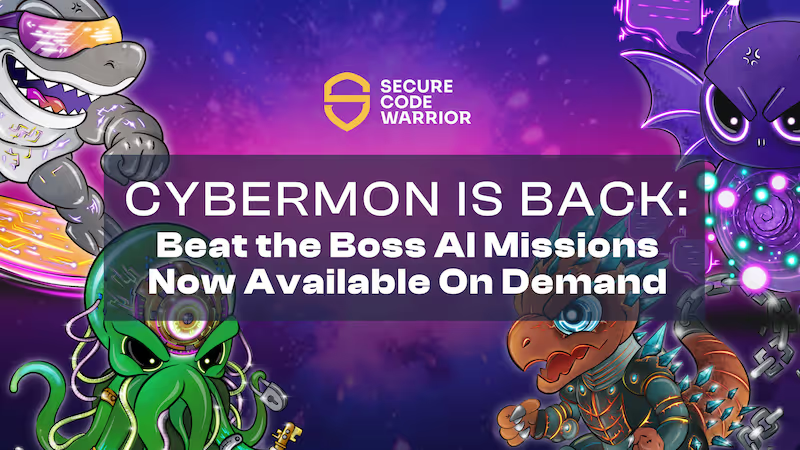
Cybermon est de retour : la mission AI pour vaincre le boss est désormais disponible sur demande.
Cybermon 2025 : la campagne « Vaincre le boss » est désormais disponible toute l'année dans SCW. La guerre de sécurité avancée de l'IA/LLM tribale, le renforcement de l'IA de sécurité à grande échelle.
5 mars 2026
Interprétation de la loi sur la résilience des réseaux : que signifie la sécurité par le biais de la conception et du développement de logiciels ?
Comprenez les exigences de la loi européenne sur la résilience des réseaux (CRA), à qui elle s'applique et comment les équipes d'ingénierie peuvent s'y préparer grâce à des pratiques de conception, à la prévention des vulnérabilités et au renforcement des capacités des développeurs.
24 février 2026